


Product Description
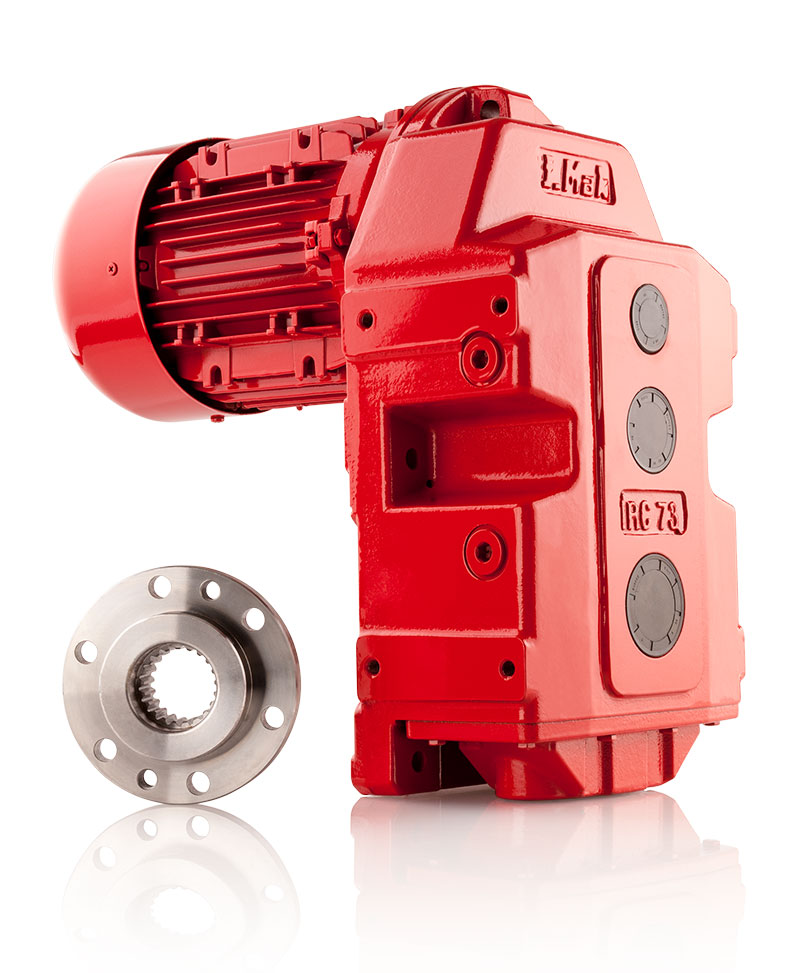
I-MAK IRC Series Gear Units
The I-MAK IRC Series Gear Units are three-stage geared drives developed for lifting and hoisting technology. Moreover, their compact construction supports demanding applications where controlled low-speed movement and high output torque are essential.
The published range supports motor powers from 0.37 to 45 kW. In addition, available configurations provide output speeds from approximately 7 to 59 rpm.
Therefore, the IRC Series suits cranes, hoists, winches and material-handling equipment that require dependable operation and efficient use of installation space.
Three-Stage Gear Design
The IRC Series uses three successive gear stages to reduce motor speed. Consequently, each stage contributes to the total reduction ratio and increases the available output torque.
This arrangement allows a standard electric motor to drive slow-moving lifting equipment. As a result, the system can raise, lower or position loads with greater control.
Moreover, the three-stage layout fits inside a compact housing. Therefore, the gearbox suits lifting machinery where available installation space is limited.
Key Benefits of the IRC Series
- Three-stage gear construction
- Developed for lifting and hoisting systems
- Motor powers from 0.37 to 45 kW
- Output speeds from approximately 7 to 59 rpm
- Maximum output torque up to 19,200 Nm
- Output shaft diameters from 35 to 120 mm
- High mechanical efficiency
- Compact, space-saving design
- Quiet operation
- Broad ratio range
- High service-factor options
- Low routine maintenance requirements
- Multiple sizes for different lifting duties
- Suitable for crane and winch applications
Together, these features support dependable lifting performance. Moreover, the broad torque and shaft range allows engineers to match the gearbox with different load capacities and drum dimensions.
Available IRC Models
I-MAK’s current product table lists:
- IRC 63: Up to 350 Nm; 35 mm shaft
- IRC 73: Up to 800 Nm; 45 mm shaft
- IRC 83: Up to 1,500 Nm; 50 mm shaft
- IRC 93: Up to 3,500 Nm; 70 mm shaft
- IRC 103: Up to 7,500 Nm; 95 mm shaft
- IRC 123: Up to 10,400 Nm; 110 mm shaft
- IRC 143: Up to 19,200 Nm; 120 mm shaft
Therefore, smaller models suit lighter lifting equipment. In contrast, larger IRC units support heavier cranes, winches and industrial hoists.
However, the maximum permitted load depends on much more than gearbox torque alone. Consequently, users must also verify drum diameter, reeving arrangement, lifting speed, duty class and required safety factors.
Controlled Low-Speed Operation
Hoisting equipment normally requires lower speeds than a standard electric motor provides. Therefore, the IRC Series reduces motor speed to a controlled gearbox output.
For example, the gearbox can drive a rope drum used to raise or lower a load. Similarly, it can power a winch that requires controlled pulling force.
Moreover, low output speeds help operators manage load movement more accurately. As a result, the system can support smoother starts, stops and positioning when paired with suitable motors, brakes and controls.
High Efficiency and Quiet Performance
I-MAK lists high efficiency as a principal IRC Series advantage. Therefore, the gearbox can transmit a large proportion of motor power to the lifting mechanism.
In addition, precision gear engagement supports quieter operation. Consequently, the IRC Series suits indoor factories, warehouses and production facilities where excessive drive noise may be undesirable.
However, correct alignment, lubrication and installation remain essential. Otherwise, poor mounting can increase vibration, heat and operating noise.
Compact Hoist Drive Construction
The compact housing reduces the space required around the lifting mechanism. Therefore, machine builders can integrate the gearbox into cranes, hoists and winches with restricted installation dimensions.
Moreover, a compact drive can reduce the length of the complete lifting assembly. As a result, designers may achieve more efficient use of the available crane or machine structure.
Low-Maintenance Industrial Operation
I-MAK describes the IRC range as durable and low maintenance. Nevertheless, low maintenance does not mean maintenance-free.
Therefore, operators should inspect:
- Lubricant condition and level
- Gearbox seals
- Mounting bolts
- Couplings and shafts
- Brakes and safety devices
- Operating temperature
- Abnormal vibration or noise
Consequently, planned inspection can identify developing problems before they cause lifting-system downtime.
IRC Series Applications in the UAE
The I-MAK IRC Series suits:
- Overhead travelling cranes
- Gantry cranes
- Industrial hoists
- Wire-rope lifting systems
- Winches
- Warehouse lifting equipment
- Manufacturing plants
- Steel-processing facilities
- Ports and logistics terminals
- Construction lifting machinery
- Material-handling systems
- Maintenance workshops
For example, an overhead crane can use an IRC gearbox to drive its hoisting drum. Similarly, an industrial winch can use the gearbox for controlled pulling or lifting.
Selecting the Correct IRC Gear Unit
Correct selection depends on:
- Maximum lifted load
- Required lifting speed
- Drum diameter
- Rope reeving arrangement
- Motor power and speed
- Required output torque
- Starts per hour
- Operating duty class
- Brake arrangement
- Required service factor
Therefore, users should complete a lifting-drive calculation before ordering. Otherwise, the gearbox may not provide the required safety margin or service life.
Why Choose I-MAK IRC Series Gear Units?
The IRC Series combines high torque with compact three-stage construction. Moreover, its broad model range supports different lifting capacities and shaft requirements.
Therefore, it is a practical choice for UAE facilities that require efficient, quiet and dependable hoist-drive performance.
Request an I-MAK IRC Gear Unit in the UAE
Contact our drive specialists for technical selection, specifications and UAE pricing.
Please provide the lifted load, lifting speed, drum diameter, reeving arrangement, motor power, operating hours and required duty class. With this information, our team can recommend the correct I-MAK IRC Series configuration.